

STEWARDS OF THE LENOX MEETING HOUSE
The Friends of the Lenox Meeting House are dedicated to preserving, restoring, and reimagining one of Lenox’s most iconic landmarks. Rooted in more than 220 years of history, the Meeting House has served as both town hall and gathering space, and today we are working to ensure it continues to serve our community for generations to come.
MEET the BOARD of DIRECTORS
WE'RE ORGANIZED AND OPERATING IN PARTNERSHIP WITH CHURCH ON THE HILL BUT INDEPENDENT OF THE CONGREGATION
Some of us are church members, others of us not. All of us are dedicated to the historical aesthetic, inspiring beauty, and energizing potential of the Lenox Meeting House, and to the welfare of the community of Lenox and beyond.

DAN BROSS
President
With a background in public policy and government affairs, Dan has over forty years of executive experience in both the corporate and nonprofit sectors, and now serves in Town government as a member of the Planning Board, having recently retired to Lenox with his husband, Rob.

SUSAN FOULDS
Susan leads a research/ advisory firm specializing in the digital customer experience for financial services firms--working remotely from her circa 1837 home in Lenox which she and her husband, John, restored. Susan has been active in addressing local planning and housing issues and supporting the Lenox Library.

JANICE MCCORMICK Emerita
Janice is the inaugural president of the FLMH. Under her nearly three-year leadership, we incorporated as a 501(c)(3), moved through Phase II of our project, won four public grants from town and state, and raised nearly $2 milion in funds for this important endeavor.

CHAUNCEY COLLINS
Treasurer
Chauncey hails from Lee and has been on the staff of the Austen Riggs Center since 1980 and its C.F.O./C.O.O since 1994. As such, he brings an innate appreciation of the New England aesthetic and spirit, and a wealth of knowledge in non-profit financial management.

PETER METZ
Peter is a physician and professor emeritus in psychiatry and pediatrics at UMass Medical school. He serves on many nonprofit boards, local and national, mostly in service of children, and is member and trustee of Church on the Hill, UCC.

DAVE DYER
Emeritus
Dave is a founding member of the board, one of the earliest people to recognize the gem we have on the Lenox hilltop, and its importance for being a monument to the New England while also a meeting house for a good present and hopeful future.

REV. LIZ GOODMAN
Secretary
Liz is the pastor of Church on the Hill and a big believer in the importance of "3rd spaces," where people can, outside of home and work, create meaningful social ties and enjoy life a little more.

MARY JO PIRETTI-MILLER
Mary Jo is a life-long resident of Lenox, and passionate about every aspect of the town. A graduate of the College of New Rochelle, she's been the Broker/Owner of Piretti Real Estate for 48 years, while also active as a volunteer on Town Committees, President of the Lenox Library Association, and a Director of both the former Lenox Savings Bank and Legacy Bank.
HISTORY OF THE LENOX MEETING HOUSE
IN EARLY MASSACHUSETTS, THERE WAS LITTLE SEPARATION BETWEEN CHURCH AND STATE
The Puritans who came to New England (mostly Massachusetts 1620-1640) saw church membership as part of citizenship.
At the time Richmond and Lenox were being formed, church and state were still closely aligned. Citizens were taxed for support of the church and men had to be members of the church to vote. A meeting house that was to function as both church and town meeting hall was a requirement for government approval of a town. Because of the mountain range running down the middle of Lot #8, two locations were needed for meeting houses and by 1767 the lot was split into the two towns we know today.
Land for the meeting house and nearby burying ground was donated by the heirs of Rev. Reynolds, one of the holders of the Ministers Grant that included much of current Lenox.
There are indications that Lenox’s original meeting house (thought to have been built around 1770) was situated in front of the current Church on the Hill. We don’t know what it looked like, but it probably would have been a simple box shape with bench seats. Here’s a drawing of the 1780 meeting house in Lee.

Between the religious tolerance acts of 1824 and the new state constitution of 1832, the remnants of theocracy disappeared and Massachusetts churches, including Church on the Hill, ceased to double as town offices, having to support themselves based on contributions from parishioners. In addition, as best as can be discerned, the burying ground became a town property.
1806
THE NEW MEETING HOUSE (AKA "THE CHURCH ON THE HILL")
At a special town meeting in 1803, it was determined the original meeting house needed to be replaced and funds were set aside to build a new one. By this time, the original one had become dilapidated while Lenox had become a successful little 19th century town. It was the county seat and a central location for education, criminal and civil trials, and commerce. The still-standing second county courthouse, which is now the Lenox Library, and the Lenox Academy are other examples of Lenox’s Federalist building spree.
Built in 1805 and dedicated on January 1, 1806, the current Meeting House would overtime come to be called the "church on the hill," as evidenced in this postcard from the late 19th century. But it began its life as a dual-purpose sanctuary and town hall. In fact, at the first Town Meeting in the new Meeting House, wood from the old one stacked behind the new was auctioned off, Congregationalists never letting anything go to waste.
As such, even given its religious role, the Meeting House was the center of town life with high levels of church attendance and all-day Sunday services and gatherings for weddings, funerals and oratory. Diary entries archived tell of children playing in the burying ground during the midday break in the Sunday service.

EVOLUTION OF THE MEETING HOUSE BUILDING
The design was to follow Asher Benjamin’s A Country Builder’s Handbook (1797) and was built by Benjamin Goddard, a joiner from Richmond.

The Lenox Meeting House showed customization from a Bullfinch design in Pittsfield including:
-
An enhanced porch on the south-facing side
-
Side doors to entry porch, now facing the cemetery and Main Street
-
A tower integrated into the building
-
Palladian windows in the tower (before installation of the clock in 1849)
-
An open-air belfry (louvres added later)
-
A bell-shaped cupola.
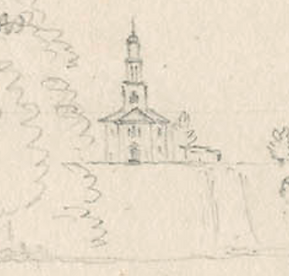
THE EARLIEST EXTANT ILLUSTRATION OF THE MEETING HOUSE IS FROM 1838
GRAPHITE ON WOVEN PAPER BY JOHN WARNER BARBER

The original interior likely had a raised pulpit, placing the pulpit closer to the floor height of the balcony, and box pews, the sale of which covered most of the cost of construction, the diagram here indicating what family in town owned what pew.

The box pews featured high sides. As there were no fires allowed in the building, parishioners probably brought boxes of coals – foot warmers – into their pews. During the winter the minister preached in a large blue overcoat and wore a red bandanna around his neck and woolen mittens on his hands. The long services broke at midday and parishioners went to nearby houses to warm themselves.

In 1840 the box pews were replaced with "slip pews" similar to those in use today. The center alley was eliminated and replaced by two large side aisles. The pulpit and the gallery front were lowered and stoves were installed in the back of the main room.
Then, in 1866, the congregation changed the layout again, featuring now a center aisle, adopting a more traditional ecclesiastical form. The easiest Congregationalists in New England were eager to depart from anything that too closely resembled the churches of the Old World. But that eased with time.
From “Buildings” by Rev. Harris B. Hinchcliffe in Church on the Hill History Gathered 1769-1970: “In 1866, the floor plan of the meetinghouse as it presently exists was set up, and in 1880 a society of young women of the church financed a projection of the front wall of the building and installed the present platform and pulpit…….”
“…..In the late 1940’s and throughout the 1950’s the meetinghouse received rather continuous efforts of modernization. Electricity was finally brought in, oil heating was installed so that for the first time in many years services might be conducted at main church building throughout the winter.”
IN THE EARLY DAYS, WORSHIPPERS WERE CALLED TO SERVICES BY THE BEATING OF A DRUM
A bell was installed at some point prior to 1838 when the Centennial History makes reference to a second bell being hung in the steeple, which was still in use as of 1906. Fanny Kemble donated a clock in 1849 that was plagued with difficulty, indeed did not "did not have an enviable reputation for telling the truth about the time of day," so it was followed by the gift of a second clock by Morris K. Jesup in 1899.

Though the stoves added to the back of the building did their best, parishioners would have had to bundle well into the 20th century. Central heating and full electrification had to wait until 1955. And, as will be discussed under detailed plans, the work of winterization is certainly not done.
In the early days, there were few hymn books and music was likely not a centerpiece of worship. Use of the violin and flute was specifically criticized because they unpleasantly resembled the flute, harp, sackbut and dulcimer which accompanied the worship of Nebuchadnezzar. By 1850, thinking on music had evolved and the rear gallery was redesigned to house an instrument called a “Seraphim” to support the singers. In 1850, the seats in the gallery in the porch were appropriated “for the use of those who assisted in singing." In 1868, the present organ was installed.
The first Bible gifted to the congregation according to records was from William Walker in 1818. Another, still in use as of 1906, was donated by his son William P. Walker in 1852. The baptismal font and tablets at the rear of the pulpit were placed in 1882 in memory of Sarah and Thomas Egleston. Two pulpit lamps, now gone, were given by Mrs. Robert E. Hill in the name of her husband Robert E. Hill, in memory of his grandfather Dr. Robert Worthington.

In 1896, Mrs. Mary Hill presented a pulpit in memory of her mother, Mrs. Jane Worthington Hill. In 1864, Ammi Robbins donated the iron fence around the whole property, Meeting House and Burying Ground, with its stone posts. His heirs gave the church society $1,000, the income of which was to be used to maintain the fence and the church grounds. Generous as that gift was, that income didn’t last to the present day. Now, fencing, church grounds, and the cemetery are maintained by the Department of Public Works of the Town of Lenox.
The building was placed on the National Register of Historic Places in 1987 and, thanks to the hard work of the congregation, the Master Plan developed and adopted in 2021 while the world was, due to Covid, confined to "Zoom." It was a good use of a constraining year. While studying the building, it was judged that the overall structure is sound, certainly worthy of preserving. But there were signs of deterioration in the windows and doors, in the access ramp and stairs, making it the right moment to take action.
